


Portfolio
AI for RF signal analysis
At Keysight I build the machine learning that tells an engineer what is on air in a recording of the radio spectrum: which signals are present, where they sit in time and frequency, and which standard they belong to.
Waveform classification and detection
The first step was a classifier and a detector for waveforms, both released. The first release was announced on LinkedIn.
- The classifier names the standard of a single recorded signal.
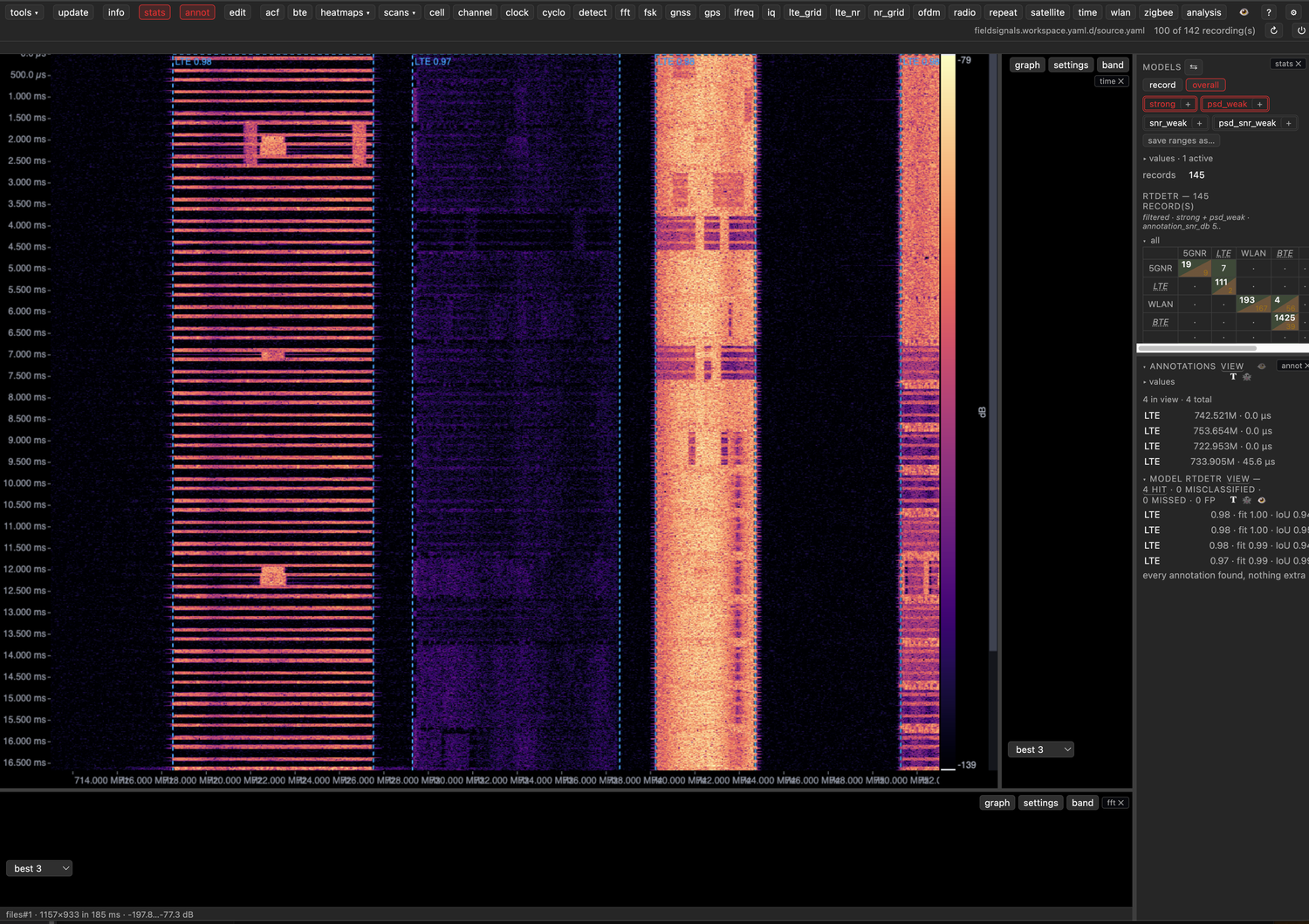
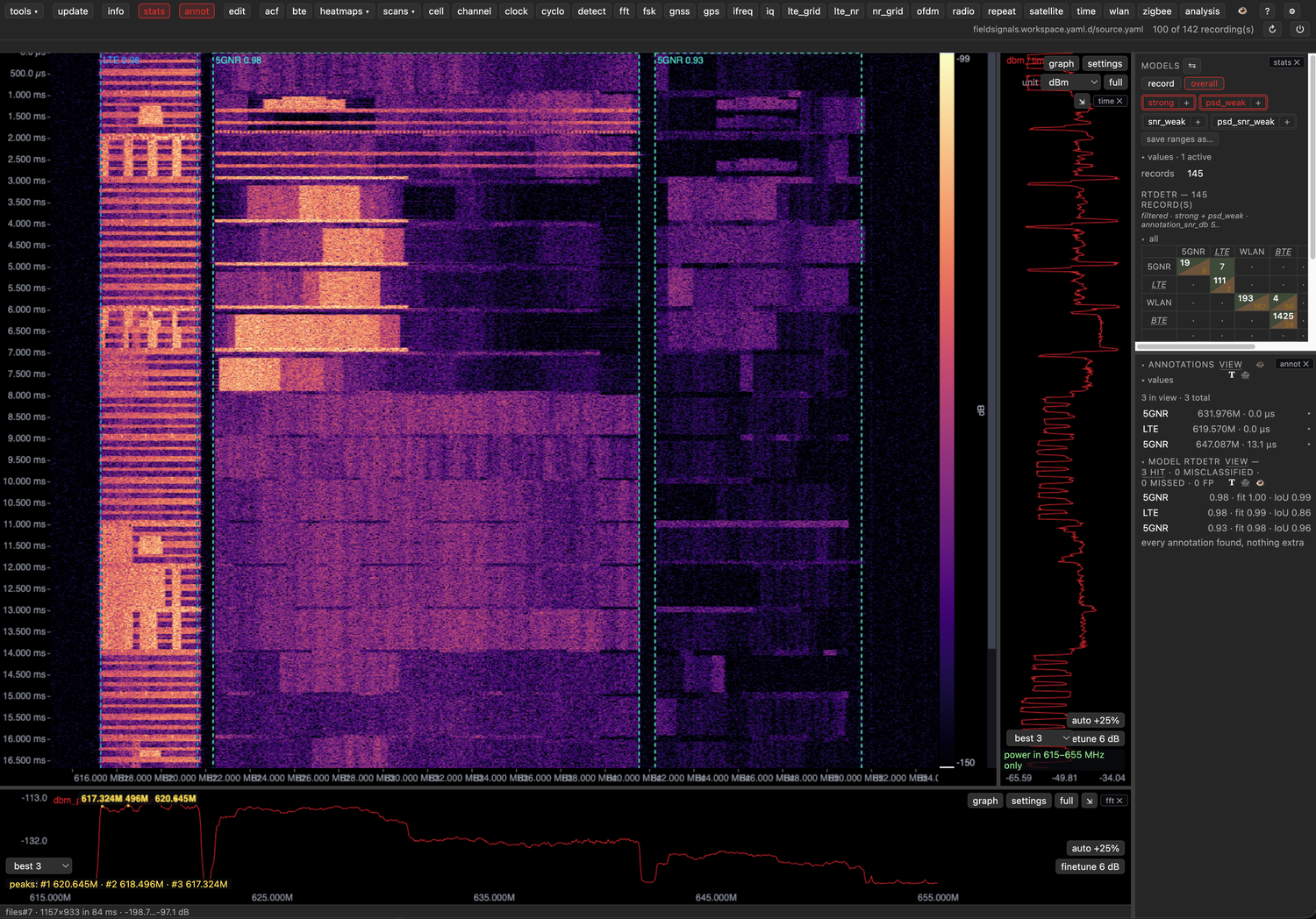
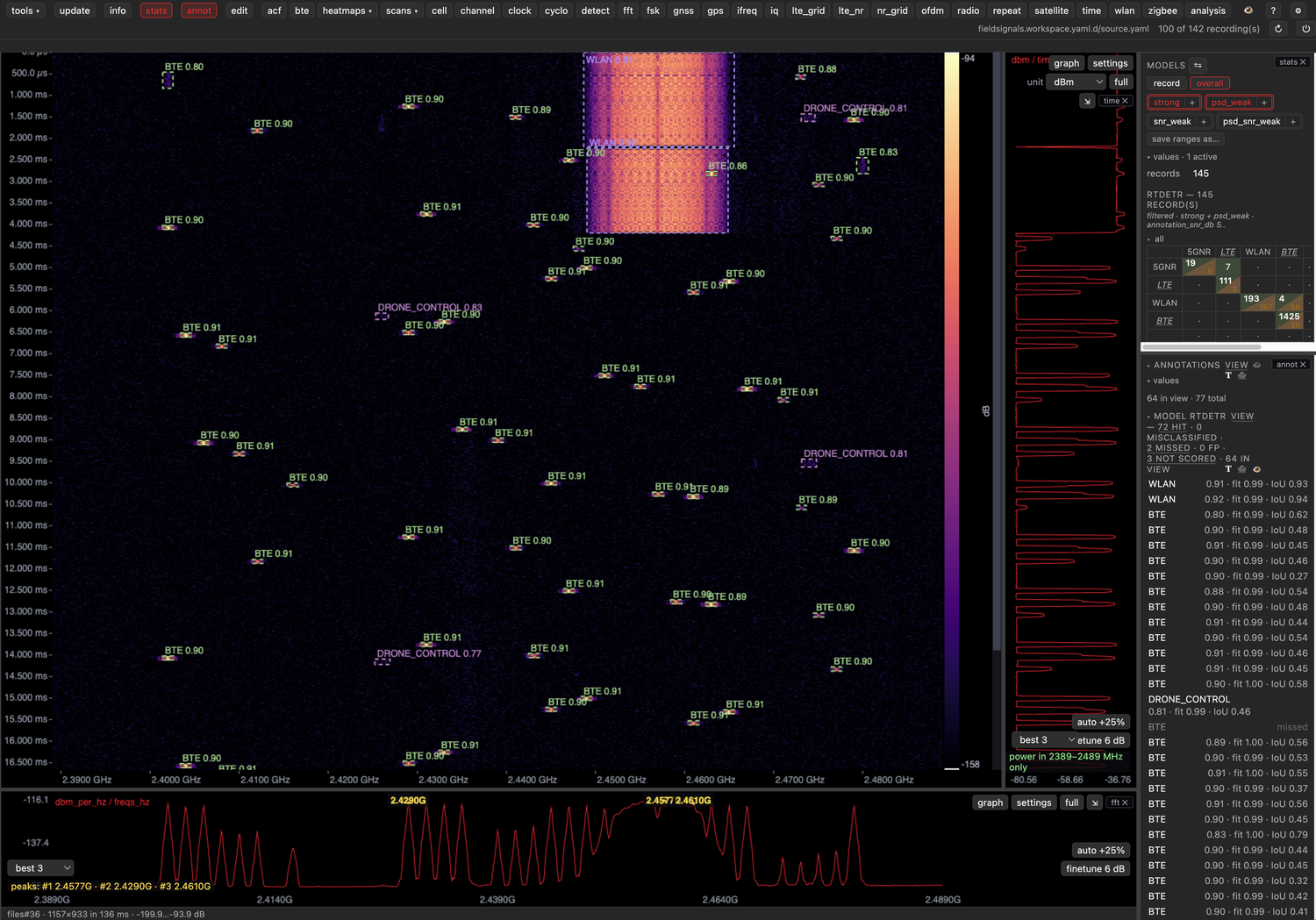
- The detector works on a wideband capture. It turns the IQ samples into a spectrogram and draws a box around every transmission, each with its class.
Real recordings with reliable labels are scarce, so most of the training data is generated. Standard-compliant waveform generators are mixed into one capture, each signal with its own transmitter errors and propagation channel, and the whole capture goes through one simulated receiver. Every generated capture comes with its boxes and masks, so no manual labelling is needed. A smaller set of annotated on-air recordings is kept apart as the truth set that every change is measured against.
The overall F1 score is above 0.95 for on-air signals with a signal-to-noise ratio above 10 dB. The model was trained purely on generated signals.
A model the user can fine-tune
A released model only knows the signals and the receivers it was trained on. The next step was a fine-tunable model with domain adapters, so that users can adapt the model to their own signals and their own equipment without retraining it from scratch.
Two methods are implemented:
- Without domain adapters. A couple of dozen examples of a new class are enough.
- With domain adapters. This method starts to work from a couple of hundred examples.
The F1 score holds for the classes added during fine-tuning, for example new drone classes.
An agentic framework for signal processing
The current work makes the whole toolchain usable by an AI agent.
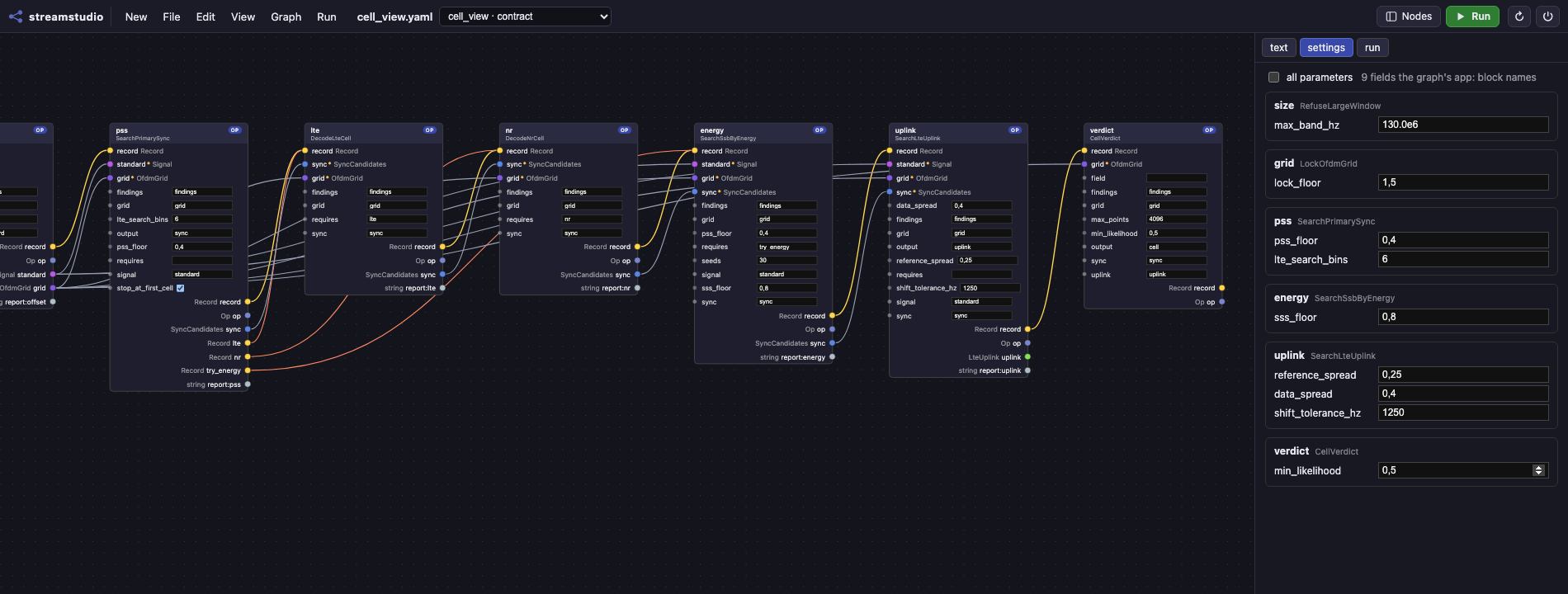
- Every step is a small configurable building block: a source, a signal processing operation, a model, a sink. A pipeline is a graph of these blocks, stored as one readable configuration file (confluid, recordstream).
- Each block describes its own parameters, with types, ranges and units. From that description the framework generates the tools an agent can call through the Model Context Protocol (navigaitor), and the forms of a visual graph editor (streamstudio). A developer writes the block once; the agent tool and the user interface follow.
- An agent can therefore discover what exists, compose a pipeline, train or evaluate a model, run an analysis on a selected part of a recording, and compare the results of earlier runs, without glue code.
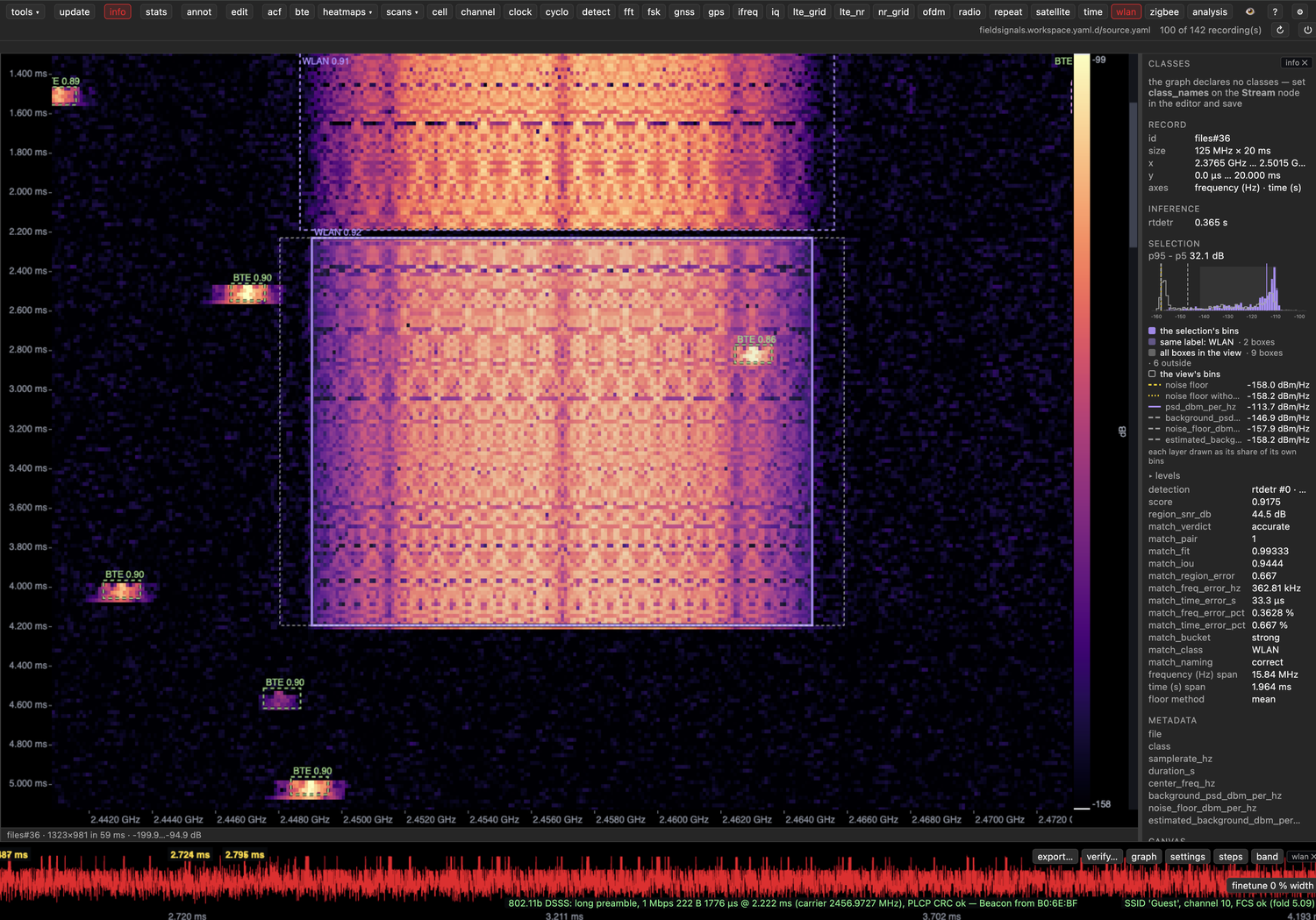
- The signal domain itself, with its sources, spectrogram operations, waveform generators and detector scoring, is one more set of blocks on top (waivefront).
Annotation and curation tools
Good models need good data, so two tools sit beside the framework.
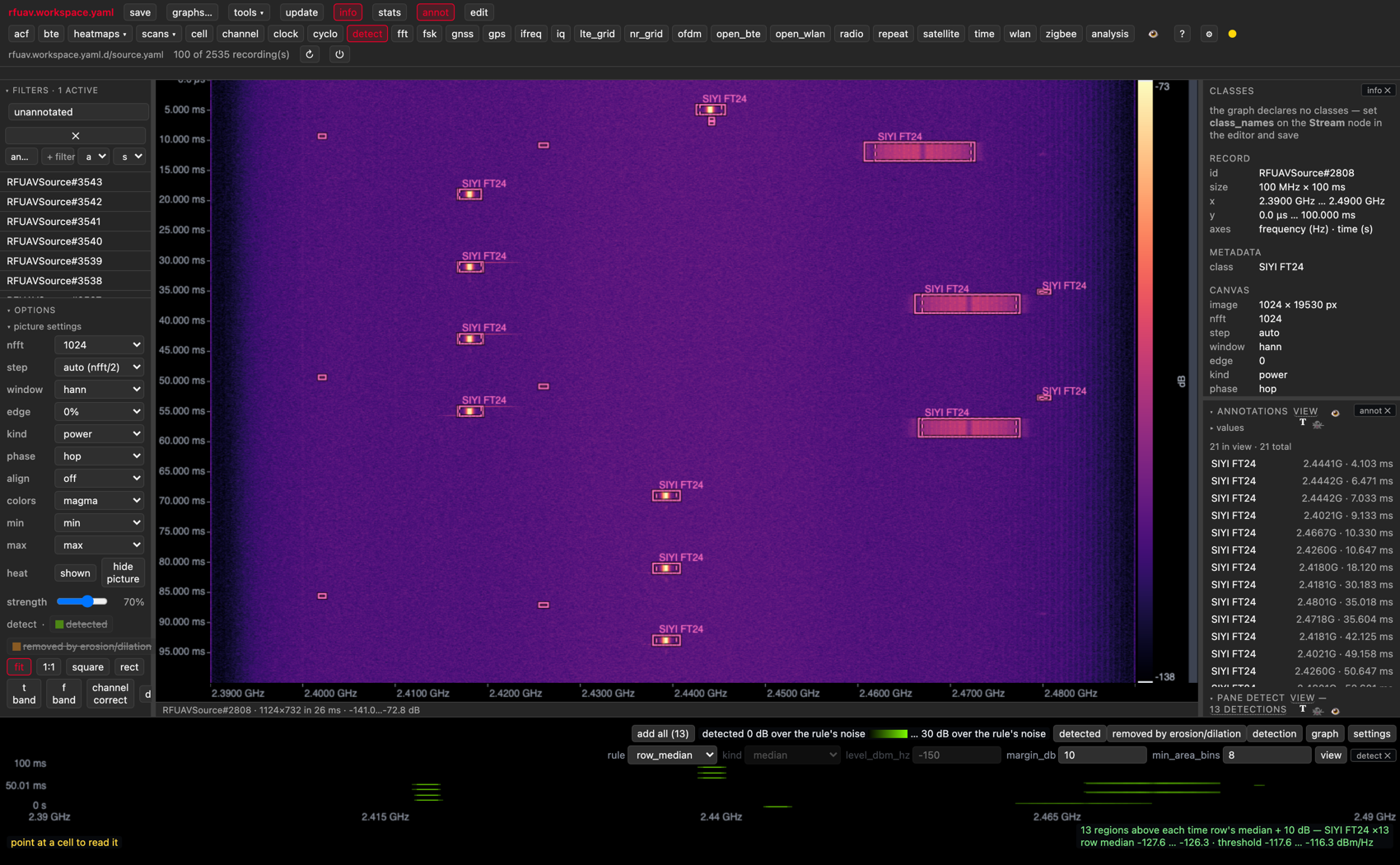
- The annotation workspace (annotaide) is a web application that shows a recording as a spectrogram, with its boxes and the predictions of a model. An example is a public set of drone recordings that comes without boxes. A pane proposes a box for every burst that rises above the noise, and the user accepts them and names the drone with one key. Once a detector is trained on these labels, the same page shows what it found, what it missed and its false alarms, window by window. For signals of a known standard, other panes decode the selected box far enough to prove what it is. The workspace is not limited to signals. It also serves the standard vision tasks, each with the project that trains its models: classification (sonair), detection (raidar), segmentation (deltaid) and restoration (distilaide).
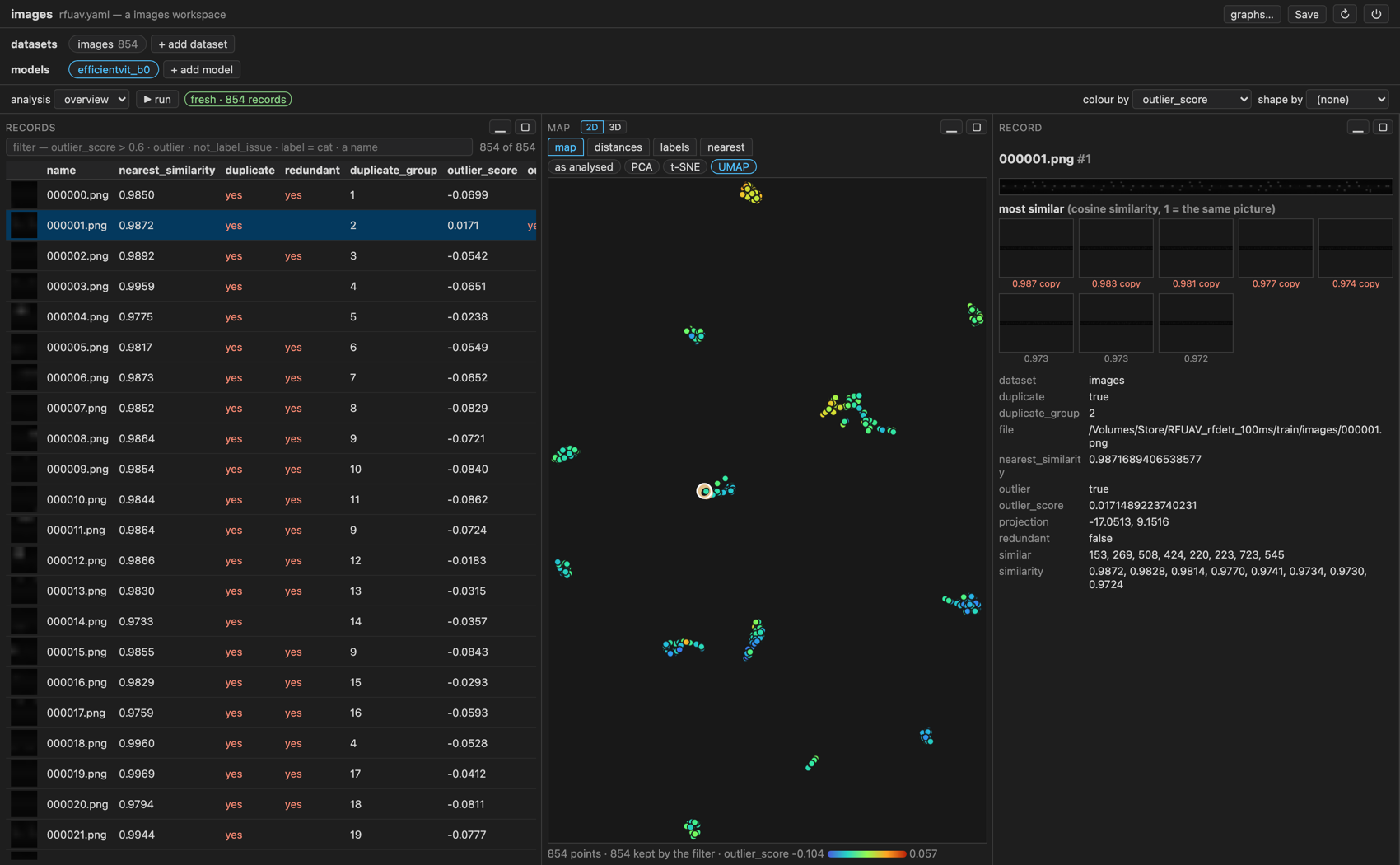
- The curation tools (curaitor) look at a dataset as a whole: outliers, near-duplicate records, label errors, and the distance between generated and real data. A remote control repeats the same bursts, so many of the training pictures cut from the drone recordings are near-copies of each other. The tool groups them, so that copies of one picture are kept together when the data is split for training. The tools work on any picture dataset, not only on spectrograms: an overview of a folder of pictures, its outliers, the label errors of a classification set (sonair), and the comparison of two datasets. Any picture opens in the annotation workspace of its task with one click.
Responsibilities
ML Engineer, AI Signal Intelligence Architect